
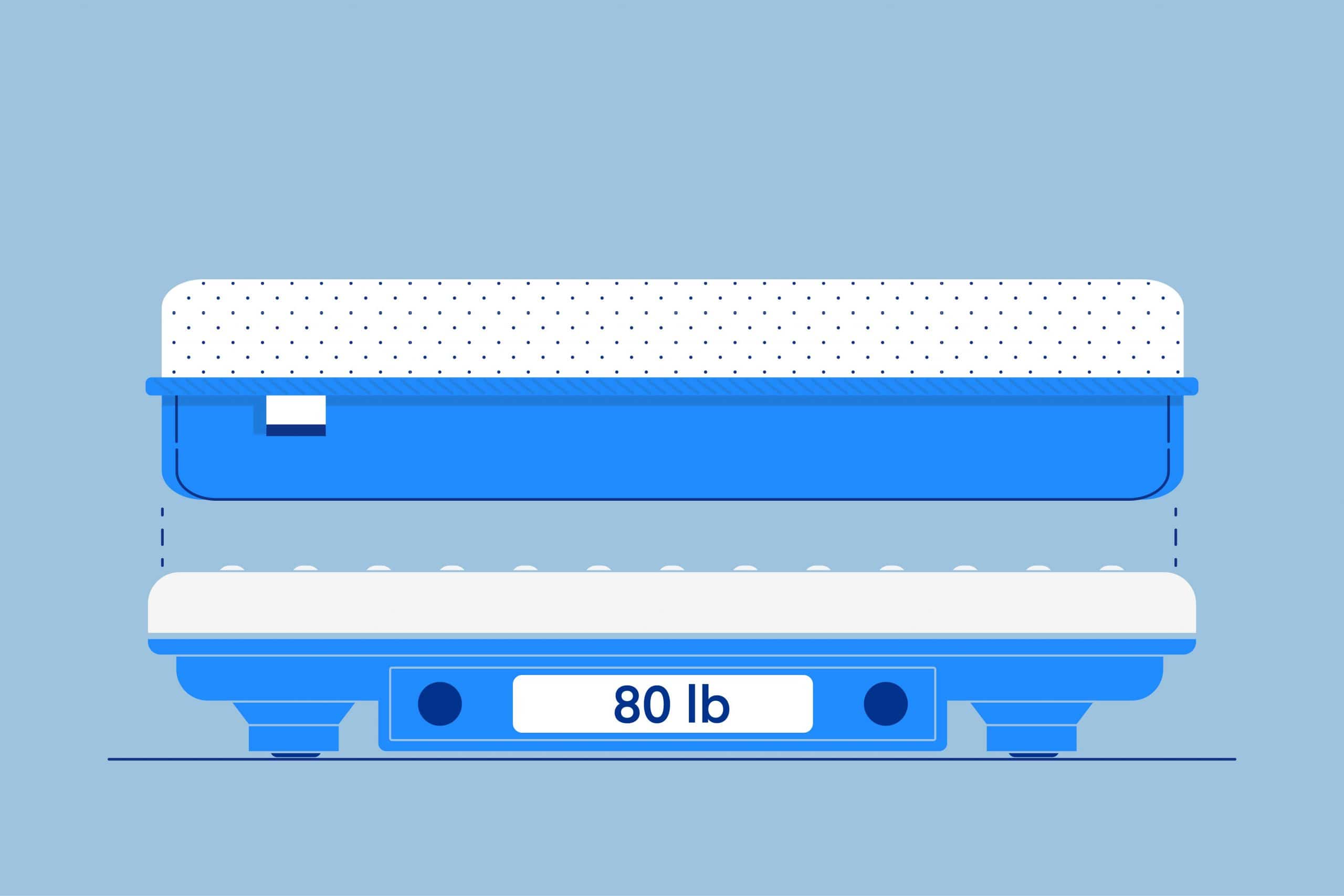
Most mattresses weigh between 50 and 180 pounds, depending on size, type, and thickness. Twin mattresses are the lightest at roughly 30 to 50 pounds, while queen, king, and California king mattresses range from 120 to 180 pounds. Latex and hybrid mattresses tend to weigh the most; airbeds weigh the least.
Powered by Amerisleep, EarlyBird brings together a dedicated team of sleep science coaches, engineers, and product evaluators. We meticulously examine Amerisleep's family of products using our unique product methodology in Amerisleep's state-of-the-art laboratory. Our commitment to sustainability is reflected in our use of eco-friendly foam in our products. Each article we publish is accurate, supported by credible sources, and regularly updated to incorporate the latest scientific literature and expert insights. Trust our top mattress selections, for your personal sleep needs.
Key Takeaways
- Weight Does Not Determine Quality: The weight of a mattress is not a direct indicator of its quality. Instead, the weight is influenced by factors such as mattress type, thickness, and size.
- Different Mattress Types: Each mattress type has a different weight due to the materials used. For example, latex mattresses are generally the heaviest, while airbeds are the lightest. Memory foam, innerspring, and hybrid mattresses fall in between in terms of weight.
- Size Matters: The size of a mattress significantly affects its weight. Larger mattresses like king and California king are heavier than smaller ones like twin or twin XL. Consider the weight of a mattress when choosing one, especially if you need to move it frequently.
Many potential customers believe that the more a mattress weighs, the higher the quality. However, weight is only a by-product of quality, not a determinate.
Mattress type, thickness, and size are significant factors that determine mattress weight. Heavier mattresses contain more materials and are more difficult to move. In our article, we go over each mattress type and size, outlining different features that could influence weight.

How Does Mattress Type Affect Mattress Weight?
While each mattress type offers its own feel, they also have a different weight, depending on their materials. For instance, latex mattresses tend to be the heaviest of all mattress types.
Memory Foam
Memory foam is a dense material, usually containing a low-density memory foam comfort layer and a higher density foam base. While not the heaviest mattress type, memory foam mattresses are heavier than innersprings.
Some memory foam mattresses also include gel-infused layers, designed to help with airflow and temperature regulation. Gel-infused foam weighs about the same as standard memory foam, since the gel is distributed in small amounts throughout the layer rather than added as a separate material.
Latex
Latex foam shares similar conforming properties as memory foam—their density is also what determines their weight. Latex mattresses can be heavier than other mattress types, depending on layers and density.
Latex mattresses can also vary in weight depending on how the latex is made, with the Dunlop or Talalay method. Dunlop latex uses a denser, more compact process, which tends to make it heavier. Talalay latex goes through an extra step that creates more air pockets, giving it a lighter, softer feel.
If you’re comparing two latex mattresses of the same size and thickness, the Dunlop version will likely weigh more.
Innerspring
Innerspring mattresses contain steel coils that act as a support base and a thin pillow top of foam or fiberfill. The open support structure makes the bed lighter and easier to move—weight depends on the coil count and coil gauge (coil thickness).
Hybrid
Hybrid mattresses combine pressure-relieving memory foam with bouncy innerspring coils. Hybrids are one of the heaviest mattress types in the industry due to the number of materials and layers they contain.
Airbed
Because airbeds rely on air for both comfort and support, they’re known as the lightest mattresses on the market. Airbeds are easy to transport and store; however, they’re also the least durable and meant as a temporary sleep solution.
How Does Mattress Thickness Affect Mattress Weight?
High-profile beds—between 12 inches to 14 inches tall—usually contain more materials or thicker layers, adding weight to the bed. Some sleepers may prefer a high-profile mattress, but keep in mind, more mattress thickness means the mattress is likely to weigh more.
| Mattress Model | Mattress Thickness | Mattress Type |
|---|---|---|
| Amerisleep AS2 | 12 Inches | Memory Foam |
| Amerisleep AS3 | 12 Inches | Memory Foam or Hybrid |
| Organica | 12 Inches | Latex Hybrid |
| Amerisleep AS5 | 14 Inches | Memory Foam or Hybrid |
| Amerisleep AS6 | 14 Inches | Memory Foam Hybrid |
| Organica Plush | 15 Inches | Latex Hybrid |
See also 10 Inch vs 12 Inch Mattresses
How Does Mattress Size Affect Mattress Weight?
Mattress sizes start off light and gradually gets heavier—king and California king mattresses are the heaviest, while twins are the lightest.
Twin
Twin size mattresses measure 38 inches by 75 inches—the smallest and lightest bed on the market. Twin mattresses are perfect for kids and single adults with limited living space. Twin beds are easy to move and set up; families with more than one child may benefit from investing in a bunk bed frame to utilize limited space.
Twin XL
Twin XL mattresses are about the same size as twin beds, but with 5 inches of extra length. Twin XL beds are great for taller people, over 6 feet tall, with more legroom to stretch out.
Full
Full size mattresses measure 56 inches by 75 inches and are better suited for teenagers and single adults. Full size beds offer more room for sleepers and weigh about 50 to 60 pounds.
Queen
Queen size mattresses measure 60 inches by 80 inches and are most popular among single adults living on their own. Queen mattresses give plenty of space for single sleepers and are good options for couples with limited room space. Queen beds weigh between 120 to 160 pounds.
King
King size mattresses measure 76 inches by 80 inches and are the largest mattress size available. King mattresses are perfect for couples, offering 38 inches of personal space. King beds often weigh between 130 to 180 pounds.
California King
California king mattresses measure 72 inches by 84 inches—the same area as king mattresses, but longer and narrower. Cal king beds are perfect for taller couples, offering more legroom. Cal king beds similarly weigh between 130 to 180 pounds.
Is a Heavier Mattress Better?
Not necessarily. A heavier mattress usually means more layers or denser materials, but that doesn’t automatically mean better sleep. Weight is a side effect of construction, not a measure of quality.
Still, some of the added weight in a heavier mattress does come from materials associated with durability, like higher-density foam, denser latex, or a higher steel coil count in an innerspring layer. Construction methods like tufting, which binds mattress layers together, can also add weight.
These materials can hold up well over time, but a lighter mattress isn’t automatically lower quality. It may simply use a different construction approach.
What matters more is whether the materials match your needs. A mattress with a higher layer count can offer more support and durability, but a lighter mattress can still perform well if it uses quality foam or coils.
The factor more consistently linked to sleep quality is firmness, not mass. A 2025 study Verified Source National Library of Medicine (NIH) World’s largest medical library, making biomedical data and information more accessible. View source found through polysomnography that people slept more consistently on a medium-firm mattress, with less variation in sleep efficiency and shorter time to fall asleep compared to soft or firm options.
A broader review Verified Source National Library of Medicine (NIH) World’s largest medical library, making biomedical data and information more accessible. View source of controlled sleep trials reached a similar conclusion, finding that medium-firm, adjustable mattresses were most consistently associated with better sleep comfort and spinal alignment across studies.
In other words, a heavier mattress isn’t inherently better, but the right firmness level for your body might matter more than either weight or material alone.
So focus on comfort, support, and materials first. Let weight be one factor among several, not the deciding one.
Why Might Mattress Weight Matter to Me?
Mattress weight isn’t just a moving-day problem. It can affect a few parts of mattress ownership:
- Setup. A heavier mattress may need two people to carry it upstairs or maneuver it into a bedroom, especially with tight staircases or hallways.
- Cleaning and flipping. Lighter mattresses are easier to rotate or vacuum on your own. Heavier mattresses may require help to flip or move for regular cleaning.
- Bed frame compatibility. Your frame or foundation needs to support the mattress’s weight. A frame rated for lighter mattresses may not hold up well under a heavier one over time.
- Delivery and shipping. Heavier mattresses can cost more to ship and may require white-glove delivery service.
None of these make a heavier mattress a bad choice. They’re just practical factors to plan around before your mattress arrives.
Does Mattress Weight Change Over Time?
Mattresses can gain a small amount of weight over years of use, as they absorb sweat, dead skin cells, and dust. But the actual change is modest, and some commonly repeated numbers about it don’t hold up well.
You may have heard that a mattress can double in weight in 10 years due to dust mites and debris. This claim traces back to a Wall Street Journal article from 2000. The Ohio State University researcher quoted in that piece later said he never made that specific claim and that it has no scientific backing. There’s no credible research supporting the idea that a mattress doubles in weight over any set period.
A separate, more modest figure, that a used mattress can contain somewhere between 100,000 and 10 million dust mites, traces back to an older Ohio State University Extension fact sheet.
That figure is still widely repeated across health and cleaning sites, but the original document is no longer published on Ohio State’s own site, and it isn’t tied to a specific peer-reviewed study. Given that, it’s best treated as a rough, dated estimate rather than a current, verifiable statistic.
The bottom line: any weight gain from normal use is real but small, nowhere near enough to meaningfully affect how a mattress feels, performs, or needs to be moved. Regular cleaning and a mattress protector help limit buildup, but weight change over time isn’t something to factor heavily into a buying decision.
What About Choosing the Right Bed Frame or Foundation?
Mattress weight and material both affect what kind of base you need.
A solid platform bed with slats spaced two to three inches apart works well for most mattress types, including latex. Slats spaced too far apart may not fully support a heavier mattress and can lead to sagging over time. Slats placed too close together can restrict airflow underneath the mattress.
Box springs are usually better suited to lighter innerspring mattresses. Denser materials like latex or memory foam can put pressure on a box spring’s frame in ways it isn’t built to handle, so a slatted platform bed or a solid foundation is typically the safer choice.
Before buying a new mattress, check your current frame’s slat spacing and weight rating, especially if you’re moving to a heavier mattress type.
FAQs
How much does an average mattress weigh?
The average mattress weighs between 50 to 150 pounds, depending on materials and size. Smaller sizes, like twin, twin XL, and full will weigh less, while queen, king, and California king beds will weigh more.
Does the weight of a mattress matter?
Some customers look at weight first when looking for a new mattress—determining mattress quality or transportation difficulty. While quality is important, potential shoppers should look at the materials themselves, like the ILD rating and density of foam or the coil count and gauge of innerspring coils.
Do mattresses have a weight limit?
Every mattress has a weight limit, no matter the mattress type. Weight limit refers to how much body weight a bed can support without the risk of sagging. Twin, twin XL, and full size mattresses can usually hold up to 400 pounds, whereas king and California king mattresses can support 400 pounds on each side of the bed, equaling 800 pounds in total.
Does a mattress actually double in weight in 10 years?
No. This is a long-running myth that it has no scientific backing. There’s no credible research showing that mattresses double in weight over any set period of time.
Does a split king weigh more than a standard king?
A split king is made up of two Twin XL mattresses placed side by side, rather than one solid mattress. Combined, the two pieces weigh about the same as a standard king mattress of the same type and thickness. The advantage is that each half can be lifted and moved separately, making a split king easier to set up or maneuver than a single king-size mattress.
Can a heavier mattress mean better quality?
Not necessarily. Weight can reflect denser materials, like higher-density foam or a higher steel coil count, which sometimes hold up longer. But a lighter mattress isn’t automatically lower quality. It may just use different materials or construction.
What’s the heaviest type of mattress?
Latex and hybrid mattresses tend to be on the heavier end due to their density and the number of material layers involved. Airbeds are the lightest, since they rely on air rather than dense foam or coils for support.
Do I need help moving a heavier mattress?
Larger sizes like king, California king, and queen are usually heavy enough that two people are recommended for moving or setting them up, especially on stairs or through tight hallways. Twin and full sizes are typically light enough for one person to manage.
Does mattress weight affect delivery cost or setup?
It can. Heavier mattresses, especially larger latex or hybrid models, may take more effort or time to bring into a home and set up. Some retailers offer white-glove delivery, which includes setup help, for shoppers who prefer not to handle a heavy mattress themselves.
Conclusion
When looking for a new mattress, whether an Eastern king bed or a smaller twin, consider weight. If you move frequently, a lighter bed might be a better option, making transportation easier. But if you’re planning on settling down in an area long-term, you may want to invest in a bigger mattress for optimal comfort.
About the author
Mitchell Tollsen is a graduate student and a freelance writer who’s contributed to the Early Bird blog for three years. Mitchell’s always been fascinated by the science of sleep and the restorative processes our bodies undergo when at rest. The self-titled “Sleep Expert” is always looking for ways to improve his shut-eye, and throughout the years has implemented numerous lifestyle changes and tried dozens of sleep-promoting gadgets to determine the best ways to truly get better rest.
View all posts